Moyai System
Designing a privacy-first, want-driven coordination system using AI-assisted full-stack development.
2026-01-21
Executive Summary
Moyai is a want-driven coordination system designed to help people quietly fulfill real needs within small, trusted communities.
Unlike marketplaces, bulletin boards, or social platforms, Moyai does not optimize for discovery, engagement, or conversation. It optimizes for a single outcome:
A real need is fulfilled with minimal exposure, minimal friction, and minimal social burden.
This system was designed and implemented in approximately one week of focused engineering effort, leveraging AI-assisted development workflows to compress iteration time without sacrificing architectural discipline.
Moyai also serves as a concrete case study in how AI can act as a force multiplier for system design, not merely code generation.
1. Problem
Community sharing is socially expensive.
In neighborhood groups, school communities, or parent circles, people are often willing to help—but existing tools introduce friction:
- Needs must be publicly broadcast
- Requests compete for attention
- Coordination happens via unstructured messaging
- Declining help creates awkward social pressure
Traditional solutions optimize for visibility and engagement. In practice, this leads to over-exposure of vulnerability and under-delivery of outcomes.
The core insight behind Moyai is simple:
Most people do not want attention. They want resolution.
2. Core Insight: Intent Is Asymmetric
Moyai is intentionally asymmetric by design.
Wants
- Represent vulnerability and need
- Are private and non-browsable
- Do not advertise themselves
- Exist primarily to be fulfilled
Gives
- Represent outward intent and generosity
- Are actively explored by the system
- Drive discovery and matching
This asymmetry is a system invariant, not a UX preference. Attempts to make wants and gives symmetric reliably increase noise, pressure, and coordination failure.
3. Matching as a Hypothesis (Not a Promise)
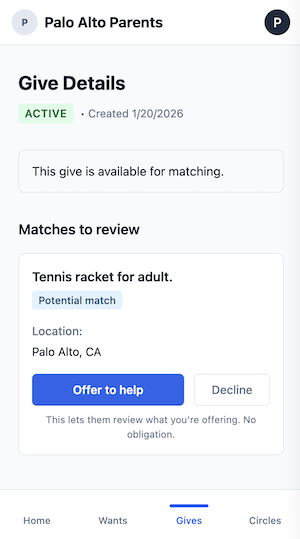
In Moyai, a match means:
“There is sufficient evidence to justify exploration.”
It does not imply obligation, guarantee, or social commitment.
This framing allows ambiguity to exist—and be resolved—without pressure. Declines are clean. Outcomes are final. Conversation is optional.
4. Want-Driven Coordination Lifecycle
The diagram below illustrates how Moyai works as a system—from private intent to resolution—while preserving privacy and minimizing social friction.
Key properties illustrated above:
- Wants are private and passive
- Giver intent gates disclosure
- Matching is tentative
- Resolution—not conversation—is the system’s goal
5. Progressive Disclosure & Coordination
Moyai avoids global feeds, inboxes, or open-ended chat.
Instead:
- Information is revealed step-by-step
- Only the minimum necessary data is disclosed
- Coordination happens through explicit decision points
Either party can decline at any time, cleanly and safely.
The system supports—but does not require—off-platform coordination once sufficient confidence exists.
6. Architecture & Responsibility Boundaries
Moyai’s architecture emphasizes deterministic behavior, privacy enforcement, and explicit state transitions.
Architectural principles
- Thin clients: UI captures intent, not authority
- Database as source of truth: RLS and state machines enforce invariants
- AI as enrichment, not control flow: AI augments decisions but does not own them
- Explicit coordination states: Prevent invalid or ambiguous transitions
This makes the system easier to reason about—both for humans and AI agents.
7. Semantic Matching & Intelligence
Moyai uses semantic understanding rather than category browsing.
- Natural language wants are enriched into structured signals
- Gives are analyzed using text and image understanding
- Vector embeddings enable similarity-based matching
- Matching is directional: gives are evaluated against wants
Importantly, enrichment is fire-and-forget:
- Want creation never blocks on AI
- Derived data is versioned and recomputable
- Failures degrade gracefully
8. AI-Assisted Development Workflow
Moyai was designed and implemented in roughly one week using coordinated AI-assisted workflows.
AI agents were used for:
- Product philosophy enforcement
- Architecture and schema design
- SQL migrations and RLS policy review
- Debugging complex edge cases
- Test scaffolding and validation
AI was treated as a collaborative engineer, not a replacement:
- Invariants were explicit
- Decisions were documented
- Trade-offs were surfaced early
Traditional engineering discipline—version control, schema migrations, logging—remained essential.
9. What Shipped
Despite the short timeline, Moyai shipped as a coherent, end-to-end system:
- Private want creation
- Public give listing
- Semantic matching
- Progressive disclosure
- Structured coordination
- Outcome capture
This was not a demo or mock-up, but a functioning system suitable for early real-world usage.
10. Lessons Learned
- AI dramatically compresses implementation time—but only with clear intent
- Architectural clarity matters more, not less, when development is fast
- Privacy and trust are best enforced structurally, not socially
- Coordination benefits from explicit states rather than conversation logs
- Cognitive load—not coding speed—becomes the dominant constraint
Closing
Moyai demonstrates that it is now feasible for a single developer to design and implement non-trivial, privacy-preserving systems in days rather than months.
More importantly, it shows that AI-assisted development can amplify system thinking, not replace it—when used deliberately and with discipline.
If a user gets what they needed, Moyai has succeeded.